Stanford researchers have found evidence that an RNA sequence called “Xist,” which is only produced by biologically female (XX) mammals, is an important factor in the etiology of many autoimmune diseases (Image: Sergii Laramenko/Shutterstock)
The
statistics have been clear and consistent for decades: autoimmune conditions are
at least three times more common among women than men. Some studies suggest
it’s more like a factor of four. For specific diseases like Lupus, the
disparity is 9-fold. For Sjogren’s syndrome, it’s 19 to 1.
This
appears to be an objective biological phenomenon. It’s not a reflection of
gender-based differences in seeking medical care, or of misdiagnosis—though
there’s plenty of that. Neither is it strictly hormone-related.
Hormonal
factors do play some role in autoimmune disorders. But the hormonal differences
between biologically female and male individuals in no way fully account for
the marked disparity of autoimmune diseases.
The presence of micro- or nano-plastic particles in carotid atheromas significantly raises the risk of myocardial infarction, stroke, or death from any cause within 3 years. That’s the blunt conclusion of a new multi-center study headed by researchers at the Department of Advanced Medical & Surgical Science, University of Campania, Naples, and involving more than […]
Eczema is seldom life-threatening, but it can have profoundly detrimental impact on the people it affects. Clinicians who can bring a holistic, root-cause approach to this common condition can make a big difference in the lives of their patients. “Roughly 20 million Americans have eczema. It’s a huge population. Patients are desperate for help, and […]
There are significant gaps in the regulation
of the supplement industry, resulting in a situation where some companies are producing
excellent, safe, and effective products with exacting quality standards, while
others are not.
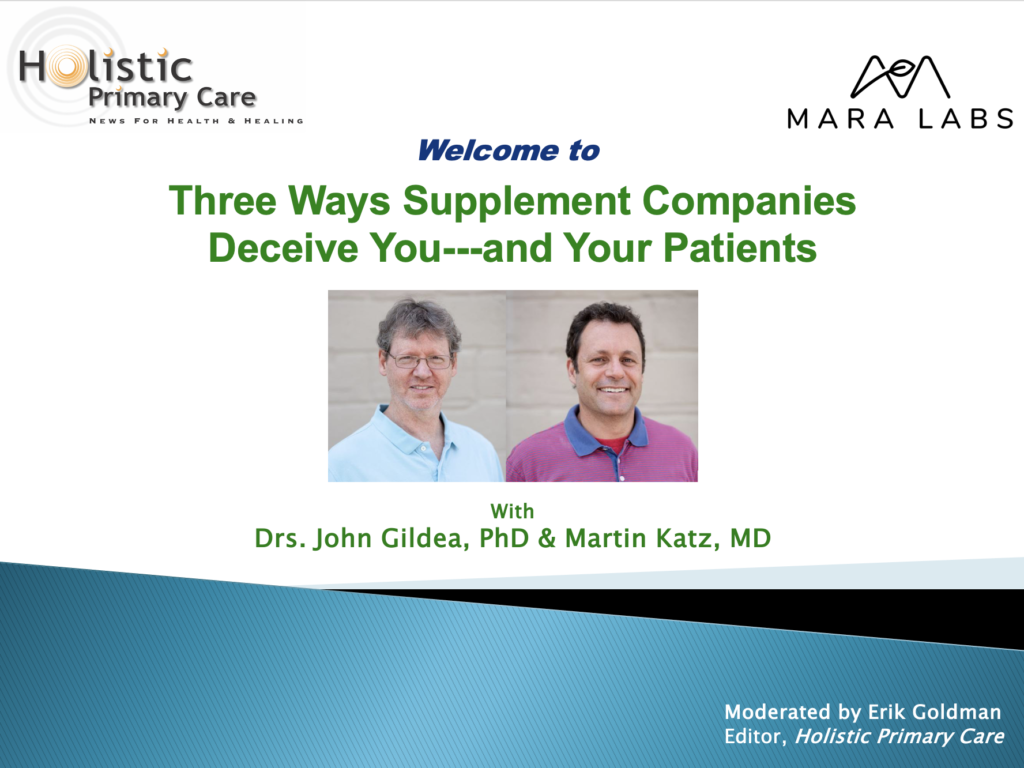
In this free webinar, we’ll go over how you
as a clinician, and your patients, can tell the difference.
Specifically, we will look at how some companies
use fillers and flow agents to make the contents of their capsules look more
substantial than they really are. We will reveal specific instances where
companies mislabel their supplement facts, and others where brands provide
serving sizes are not biologically relevant. Lastly, we’ll look at one popular
curcumin product that may actually be harmful.
Our
presenters, Martin Katz, MD, and John Gildea, PhD, will cover:
How to determine how much
filler is in a supplement capsule—and why that matters
Common supplement industry
mislabeling tricks
Popular supplement ingredients that are typically not
bioavailable enough to have clinically relevant impact on human physiology
John Gildea, PhD, is a Johns
Hopkins-trained pathologist and researcher, who has authored 60 scientific
publications from over 20 NIH-funded studies. He is an expert in cell culture
and exosomes, and directed all the science behind the gut supplement, RESTORE. Dr.
Gildea was instrumental in the initial stabilization of the sulforaphane
in BrocElite®.
Martin Katz, MD, is double
board certified in Sports and Family Medicine. He is committed to a
preventative medicine paradigm, educating his patients regarding the benefits
of intentional nutrition, exercise, sleep, the microbiome, and connectivity.
Dr. Katz earned his MD degree from the Medical University of South Carolina,
and practices in Charlottesville, VA.